
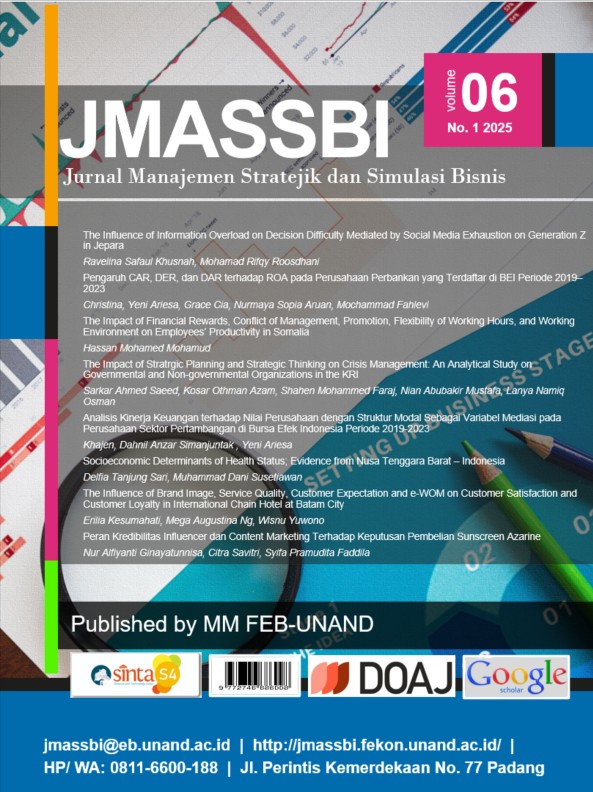
The Impact of Stratrgic Planning and Strategic Thinking on Crisis Management: An Analytical Study on Governmental and Non-governmental Organizations in the KRI
DOI:
https://doi.org/10.25077/mssb.6.1.45-58.2025Keywords:
Strategic planning, Strategic thinking, Crisis managementAbstract
Crises of organizational misdeeds arise when management takes certain decisions knowing the harmful consequences of the same towards the stakeholders and external parties. The purpose of this study is to determine the impact of strategic planning and strategic thinking on crisis management. The importance of our research is that crisis management, A timely and accurate response to any critical incident is critical to mitigating impacts, a successful crisis management plan can prevent delays, and strategic thinking helps you identify opportunities for change, and take advantage of them. It also helps staff anticipate crises that may occur in the future. The study was conducted through Google Form. A survey of Kurdistan Regional Government residents aged 20 to over 60 years and residents of Halabja, Suleimani and surrounding areas, through a simple Random sample. Approximately 120 respondents were recruited who were recruited through an adaptive questionnaire. After analyzing the data through SPSS and its Correlation and regression models. Finally, strategic thinking and strategic planning play a crucial role in effective crisis management. By anticipating potential crises, developing proactive strategies and implementing structured plans, organizations can better navigate uncertain and challenging situations. Overall, integrating strategic thinking and planning into crisis management processes can enhance an organization’s ability to mitigate risks, respond quickly, and recover quickly from crises.
Downloads
References
Abudlqadir, A. H., Hama, B. E., & Faraj, S. M. (2020). The effects of financial crisis on birth rates in Halabja province from 2014 to 2018. Economics, Management and Sustainability, 5(2), 132-137.
Al‐Janabi, A. S., Al‐Bayati, A. F., ALtaie, O. A., Elzupir, A. O., & Yousef, T. A. (2022). Co (II), Ni (II), and Zn (II) complexes of 5‐methyl‐1, 3, 4‐oxadiazol‐2‐amine Schiff base as potential heat shock protein 90 inhibitors: Spectroscopic, biological activity, density functional theory, and molecular docking studies. Applied Organometallic Chemistry, 36(12), e6899.
Allahveisi, A., Yousefian, E., Rezaie, M., & Nikkhoo, B. (2019). Comparison of morphometric and morphology oocytes after in vitro maturation between healthy women and patients with polycystic ovarian syndrome. Acta Endocrinologica (Bucharest), 15(3), 295.
Alvarez, S., Newman, A. B., Barney, J., & Plomaritis, A. (2023). Creating stakeholder legitimacy in the eyes of stakeholders: The case of Havana’s paladares. Entrepreneurship Theory and Practice, 47(1), 17-65.
Bier-Laning, C., Cramer, J. D., Roy, S., Palmieri, P. A., Amin, A., Anon, J. M., . . . Cognetti, D. M. (2021). Tracheostomy during the COVID-19 pandemic: comparison of international perioperative care protocols and practices in 26 countries. Otolaryngology–Head and Neck Surgery, 164(6), 1136-1147.
Blbas, H. T., & Faraj, S. M. (2022). A statistical study of the influence of COVID-19 on the agricultural supply chain (vegetative) production in Halabja governorate. Cihan University-Erbil Scientific Journal, 6(1), 1-6.
Blbas, H. T. A., Kahwachi, W. T. S., Ahmed, S. K., Aziz, K. G., Faraj, S. M., & Mohammed, M. S. (2024). Factors contributing to vitamin D deficiency in Erbil, Iraq: A statistical investigation. Clinical Nutrition Open Science, 54, 151-162.
Boin, A., McConnell, A., & t Hart, P. (2008). Governing after crisis: Cambridge University Press.
Bouhali, R., Mekdad, Y., Lebsir, H., & Ferkha, L. (2015). Leader roles for innovation: Strategic thinking and planning. Procedia-Social and Behavioral Sciences, 181, 72-78.
Faraj, S. M. (2024a). Application of Grey Forecasting Models for Forecasting the Number of Marriages in Halabja Governorate-Iraq. Khazayin of Economic and Administrative Sciences, 170-181.
Faraj, S. M. (2024b). Performance Evaluation of Machine Learning Algorithms for Predictive Classification of Anemia Data. University of Kirkuk Journal For Administrative and Economic Science, 14(3).
Faraj, S. M., Azam, K. O., Ali, Z. O., & Hussein, S. K. (2024). The Assessing the effect of Business Intelligence and Innovation on business startups: A Case Study Approach. Jurnal Manajemen Stratejik dan Simulasi Bisnis, 5(2).
Faraj, S. M., & Jafr, M. M. (2020). The Relationship and Effect of Social Media on Student’s Academic Performance:-University of Halabja as an Example. Halabja University Journal, 5(4), 326-339.
Faraj, S. M., Salih, D. T. M., Azam, K. O., Saeed, S. A., Mahmood, O. M., & Kareem, A. H. R. (2024). The Impact of Teacher and Parental Involvement on Students' Academic Performance: A Statistical Analysis in the Kurdistan Region of Iraq. Journal of Philology and Educational Sciences, 38-58.
Greening, D. W., & Gray, B. (1994). Testing a model of organizational response to social and political issues. Academy of Management journal, 37(3), 467-498.
Groh, A. M., Fearon, R. P., Bakermans-Kranenburg, M. J., Van IJzendoorn, M. H., Steele, R. D., & Roisman, G. I. (2014). The significance of attachment security for children’s social competence with peers: A meta-analytic study. Attachment & human development, 16(2), 103-136.
Jaques, T. (2009). Issue and crisis management: Quicksand in the definitional landscape. Public Relations Review, 35(3), 280-286.
Koushafard, S. (2013). Strategy in crisis management.
Krasnici, V., & Fors Lindeberg, M. (2020). Strategic Thinking in Crisis Management: A Study into how Organisations Use Strategic Thinking to Overcome Unusually Demanding Situations. In.
Mitroff, I. I., Pearson, C. M., & Harrington, L. K. (1996). The essential guide to managing corporate crises: A step-by-step handbook for surviving major catastrophes. (No Title).
Nadler, D. A. (1994). Collaborative strategic thinking. Planning Review, 22(5), 30-44.
Omer, A., Faraj, S. M., & Mohamad, S. H. (2023). An application of two classification methods: hierarchical clustering and factor analysis to the plays PUBG. Iraqi Journal of Statistical Sciences, 20(1), 25-42.
Parnell, J. A., Koseoglu, M. A., & Dent, E. B. (2012). Propensity for participative decision making (PPDM) in Turkey and the USA. International Journal of Business Excellence, 5(3), 278-304.
Pearson, C. M., & Clair, J. A. (1998). Reframing crisis management. Academy of management review, 23(1), 59-76.
Porter, M. E. (1996). What is strategy?
Rached, G., Hobeika, C., Karam, E., Kourié, H. R., & Kattan, J. (2018). Urging medical students to publish: Advantages, disadvantages and new challenges. In (Vol. 105, pp. 626-628): Elsevier.
Ridgley, L. A., Anderson, A. E., Maney, N. J., Naamane, N., Skelton, A. J., Lawson, C. A., . . . Pratt, A. G. (2019). Il-6 mediated transcriptional programming of naïve CD4+ T cells in early rheumatoid arthritis drives dysregulated effector function. Frontiers in immunology, 10, 1535.
Sharif, Z. F., Azam, K. O., Saeed, S. A., Blbas, H. T. A., Faraj, S. M., Mohammed, F. A., & Ali, A. S. (2025). The Impact of Organizational Integrity on Organizational Symmetry: An Analytical Study in the Public and Private Sectors: Impact of Organizational Integrity on Organizational Symmetry. Academic Journal of International University of Erbil, 2(02), 129-142.
Vargo, J., & Seville, E. (2011). Crisis strategic planning for SMEs: finding the silver lining. International Journal of production research, 49(18), 5619-5635.
Waryjas, M. (1999). Effective crisis management: Grace under pressure. KMZ Rosenman Katten Muchin Zavis Rosenman, 1-16.
Yusuf, M. B., Amsbaugh, M. J., Burton, E., Chesney, J., & Woo, S. (2017). Peri-SRS administration of immune checkpoint therapy for melanoma metastatic to the brain: investigating efficacy and the effects of relative treatment timing on lesion response. World Neurosurgery, 100, 632-640. e634.
Downloads
Published
How to Cite
Issue
Section
License
Copyright (c) 2025 sarkar ahmed saeed, Kosar Othman Azam, Shahen Mohammed Faraj, Nian Abubakir Mustafa, Lanya Namiq Osman

This work is licensed under a Creative Commons Attribution-NonCommercial-ShareAlike 4.0 International License.


