
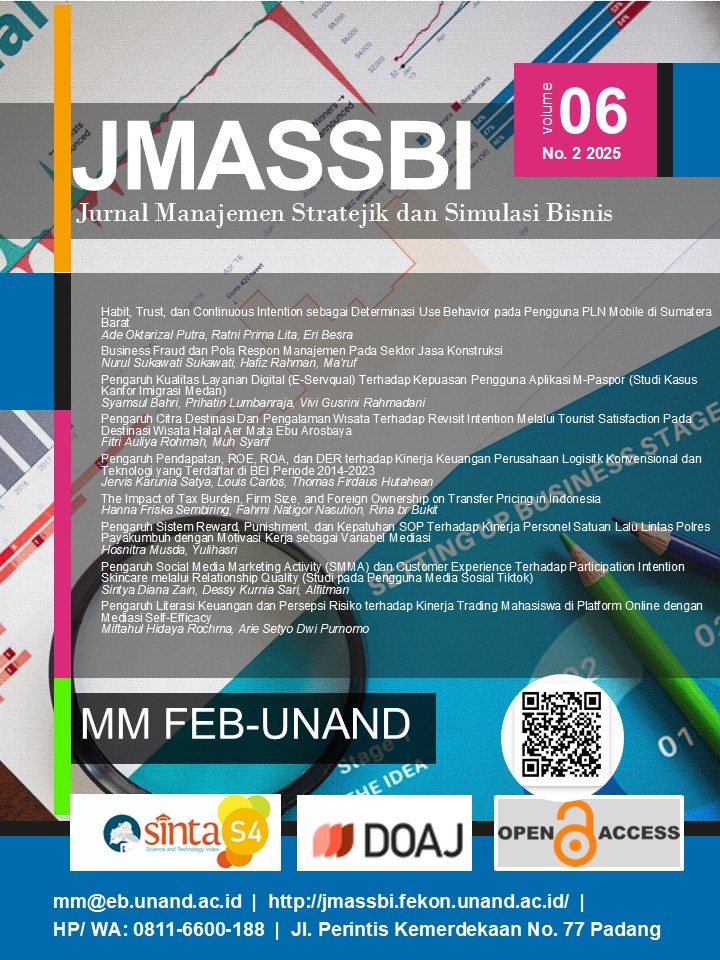
Habit, Trust, dan Continuous Intention sebagai Determinasi Use Behavior pada Pengguna PLN Mobile di Sumatera Barat
DOI:
https://doi.org/10.25077/mssb.6.2.1-14.2025Keywords:
PLN Mobile, Continuous Intention, Habit, Perceived Trust, Use BehaviorAbstract
Transformasi digital dalam pelayanan publik telah mendorong pengembangan aplikasi PLN Mobile untuk meningkatkan kepuasan pelanggan. Namun, rendahnya tingkat pengguna aktif menyoroti kebutuhan untuk mengeksplorasi faktor-faktor yang mempengaruhi penggunaan aplikasi yang berkelanjutan. Penelitian ini bertujuan untuk menguji pengaruh kebiasaan dan kepercayaan yang dirasakan terhadap intensi berkelanjutan, dan pengaruh kebiasaan dan intensi berkelanjutan terhadap perilaku penggunaan. Pendekatan penelitian kuantitatif dengan metode penelitian eksplanatori digunakan, dengan melibatkan 160 pengguna PLN Mobile di Sumatera Barat. Data dikumpulkan melalui kuesioner online dan dianalisis menggunakan Partial Least Squares Structural Equation Modeling (PLS-SEM) melalui SmartPLS 3.0. Hasil penelitian menunjukkan bahwa semua hubungan yang dihipotesiskan signifikan secara statistik. Habit dan Trust secara positif mempengaruhi Continuous Intention, dan baik Trust dan Continuous Intention secara signifikan mempengaruhi perilaku penggunaan. Nilai R-Square yang sebesar 0,73 untuk intensi berkelanjutan dan 0,69 untuk user behavior penggunaan menunjukkan prediktabilitas model yang kuat. Temuan ini menegaskan pentingnya menumbuhkan Habit dan Trust pengguna untuk mendukung adopsi layanan digital yang berkelanjutan. Studi ini memberikan kontribusi implikasi praktis untuk mengembangkan strategi digital yang berpusat pada pelanggan dan menyarankan variabel perluasan untuk penelitian di masa depan dalam konteks teknologi layanan publik.
Downloads
References
Ahuja, V., & Khazanchi, D. (2016). Creation of a Conceptual Model for Adoption of Mobile Apps for Shopping from E-Commerce Sites–An Indian Context. Procedia Computer Science, 91, 609–616. https://doi.org/10.1016/j.procs.2016.07.152
Alalwan, A. A., Dwivedi, Y. K., & Rana, N. P. (2017). Factors influencing adoption of mobile banking by Jordanian bank customers: Extending UTAUT2 with trust. International journal of information management, 37(3), 99-110. https://doi.org/10.1016/j.ijinfomgt.2017.01.002
Alrawad, M., Lutfi, A., Almaiah, M. A., & Elshaer, I. A. (2023). Examining the influence of trust and perceived risk on customers intention to use NFC mobile payment system. Journal of Open Innovation: Technology, Market, and Complexity, 9(2). https://doi.org/10.1016/j.joitmc.2023.100070
Bougie, R., & Sekaran, U. (2019). Research Methods for Business: A Skill-Building Approach (8th ed.). John Wiley & Sons.
Cheng, Y., Sharma, S., Sharma, P., & Kulathunga, K. M. M. C. B. (2020). Role of personalization in continuous use intention of Mobile news apps in India: Extending the UTAUT2 model. Information, 11(1), 33. https://doi.org/10.3390/info11010033
Dayour, F., Adongo, C. A., & Agyeiwaah, E. (2020). Continuous intention to use mobile money (MM) services: Driving factors among small and medium-sized tourism and hospitality enterprises (SMTHEs). Africa Journal of Management, 6(2), 85–114. https://doi.org/10.1080/23322373.2020.1753495
de Oliveira Santini, F., Ladeira, W. J., Pinto, D. C., Herter, M. M., Sampaio, C. H., & Babin, B. J. (2020). Customer engagement in social media: a framework and meta-analysis. In Journal of the Academy of Marketing Science (Vol. 48, Issue 6, pp. 1211–1228). Springer. https://doi.org/10.1007/s11747-020-00731-5
Gefen, Karahanna, & Straub. (2003). Trust and TAM in Online Shopping: An Integrated Model. MIS Quarterly, 27(1), 51. https://doi.org/10.2307/30036519
George, A., & Sunny, P. (2023). Why do people continue using mobile wallets? An empirical analysis amid COVID-19 pandemic. Journal of Financial Services Marketing, 28(4), 807–821. https://doi.org/10.1057/s41264-022-00174-9
Hair, J. F., Risher, J. J., Sarstedt, M., & Ringle, C. M. (2019). European Business Review (Vol. 31). Emerald Publishing.
Hair, J. F., William Black, Barry J. Babin, & Rolph E. Anderson. (2010). Multivariate Data Analysis: A Global Perspective (7th ed.). Pearson Education.
Hirt, S. G., & Cheung, C. M. K. (2007). How Habit Limits the Predictive Power of Intention: The Case of Information Systems Continuance 1 (Vol. 31, Issue 4).
Indrawati, & Putri, D. A. (2018). Analyzing factors influencing continuance intention of E-payment adoption using modified UTAUT 2 Model: (A case study of Go-Pay from Indonesia). 2018 6th International Conference on Information and Communication Technology, ICoICT 2018, 167–173. https://doi.org/10.1109/ICoICT.2018.8528748
Jiang, J., Ma, J., Huang, X., Zhou, J., & Chen, T. (2024). Extend UTAUT2 Model to Analyze User Behavior of China Construction Bank Mobile App. SAGE Open, 14(4). https://doi.org/10.1177/21582440241287070
Lew, S., Tan, G. W. H., Loh, X. M., Hew, J. J., & Ooi, K. B. (2020). The disruptive mobile wallet in the hospitality industry: An extended mobile technology acceptance model. Technology in Society, 63. https://doi.org/10.1016/j.techsoc.2020.101430
Ly, H. T. N., Khuong, N. V., & Son, T. H. (2022). Determinants Affect Mobile Wallet Continuous Usage in Covid 19 Pandemic: Evidence from Vietnam. Cogent Business and Management, 9(1). https://doi.org/10.1080/23311975.2022.2041792
Närvänen, E., Kuusela, H., Paavola, H., & Sirola, N. (2020). A meaning-based framework for customer loyalty. International Journal of Retail and Distribution Management, 48(8), 825–843. https://doi.org/10.1108/IJRDM-05-2019-0153
Putri, D. A. (2018). Analyzing factors influencing continuance intention of epayment adoption using modified UTAUT 2 model. 2018 6th International Conference on Information and Communication Technology (ICoICT), 167– 173.
Ramírez-Correa, P., Rondán-Cataluña, F. J., Arenas-Gaitán, J., & Martín-Velicia, F. (2019). Analysing the acceptation of online games in mobile devices: An application of UTAUT2. Journal of Retailing and Consumer Services, 50, 85-93. https://doi.org/10.1016/j.jretconser.2019.04.018
Shmueli, G., Sarstedt, M., Hair, J. F., Cheah, J.-H., Ting, H., Vaithilingam, S., & Ringle, C. M. (2019). Predictive model assessment in PLS-SEM: guidelines for using PLSpredict. European Journal of Marketing, 53(11), 2322–2347. https://doi.org/10.1108/EJM-02-2019-0189
Söllner, M., Mishra, A. N., Becker, J. M., & Leimeister, J. M. (2024). Use IT again? Dynamic roles of habit, intention and their interaction on continued system use by individuals in utilitarian, volitional contexts. European Journal of Information Systems, 33(1), 80–96. https://doi.org/10.1080/0960085X.2022.2115949
Steinhoff, L., & Palmatier, R. W. (2021). Commentary: Opportunities and challenges of technology in relationship marketing. Australasian Marketing Journal, 29(2), 111–117. https://doi.org/10.1016/j.ausmj.2020.07.003
Tamilmani, K., Rana, N. P., Wamba, S. F., & Dwivedi, R. (2021). The extended Unified Theory of Acceptance and Use of Technology (UTAUT2): A systematic literature review and theory evaluation. International Journal of Information Management, 57. https://doi.org/10.1016/j.ijinfomgt.2020.102269
Tan, K. L., Leong, C. M., & Richter, N. F. (2024). Navigating Trust in Mobile Payments: Using Necessary Condition Analysis to Identify Must-Have Factors for User Acceptance. International Journal of Human-Computer Interaction. https://doi.org/10.1080/10447318.2024.2338319
Venkatesh, V., Walton, S. M., & Thong, J. Y. L. (2012). Quarterly Consumer Acceptance and Use of Information Technology: Extending the Unified Theory of Acceptance and Use of Technology1. https://about.jstor.org/terms
Zhanyou, W., Dongmei, H., & Yaopei, Z. (2020). How to improve users’ intentions to continued usage of shared bicycles: A mixed method approach. PLoS one, 15(2), e0229458.
Downloads
Published
How to Cite
Issue
Section
License
Copyright (c) 2025 Ade Oktarizal Putra, Ratni Prima Lita, Eri Besra

This work is licensed under a Creative Commons Attribution-NonCommercial-ShareAlike 4.0 International License.


